Showing posts with label 1960s pop. Show all posts

Monday, 22 August 2011

Gene Pitney - Backstage (1966/ No. 4/ 10 weeks/ Stateside)

I can never understand why Gene Pitney doesn't have the same kudos as Roy Orbison. Both men worked within the same form, the highly melodramatic ballad, and both used highly distinctive voices to extract the maximum possible emotion out of their material. Both singers also always came across as being genuinely humble and modest in interviews.

In Pitney's case, the voice is a quavering adenoidal tenor, purpose built for the expression of anguish. The amazing thing about this voice is that it will build and build throughout a song, and then - just when the listener thinks that things couldn't possibly get any more exciting or compelling - build some more, reaching a kind of delirious catharsis.

The songs that he interpreted were generally short and unhappy. They are usually tales of lost love, or the fear of being about to lose love. When, less often, Pitney sings about finding love, the effect is equally uncomfortable, because he tends to be consumed by guilt at stealing someone's girl or cheating on someone, most famously in '24 Hours From Tulsa'. 'Backstage' is a definitive lost love tale, given a metatheatrical spin through being the story of a successful pop star.

A brief drum-roll and fanfare sets the scene. "Ladies and gentlemen, tonight's star attraction";

A thousand hands -
applaud tonight...
I sing my songs...
My star shines bright...
I stop and smile...
I take my bow...
I leave the stage...
and then some-how -

Hubris is swiftly followed by nemesis;

Backstage I'm lonelee
Backstage I cry
You've gone away

Diminuetto;

and each night
I seem
to die
a little...

On the second verse, Pitney becomes notably louder and more desperate-sounding;

Out on that stage
I'll play the star
I'm famous now!
I've come so far..
A famous FOOL!
I let love GO!
I didn't KNOW!
I'd miss you SO!

It's taken a while to get there, but the second chorus brings the first extended anguished phrase;

Backstage I'm lonelee!
Backstage I cry
Hating myself
since I let you say -
GOODBYYYYYYYYE!

A middle eight cranks up the tempo, the strings echoing the singer's manic excitement;

Every night a different girl!

(jajajajajajaJA!)

Every night a different club!

(jajajajajajaJA!)

And yet I'm lonely all the time...

(swirlywirlwirlwirl)

When I sign my auto-graph!

(jajajajajajaJA!)

When I hold an in-ter-view!

(jajajajajajaJA!)

Can't get you out of my MIIIIND!

The point of self-revelation;

Come back my love!
Come back to me!
I need you now!
So desperatelee!
What good is fame?
It's just a game!
I'd give it awll to be the same

Backstage I wait now -
ho-ping I'll see
Your smiling face waiting there backstage for meeee-eeee!

(A trumpet backs that "meeee-eeee!")

Your SMI!LING! face waiting backstage for meeeeee-eeeeee!

She won't be there. Surely that's it?

No. Pitney reminds us of the scene;

BACKSTAAAAAAAAGE!

And them, that astonishing Roy Orbison trick of taking things one stage further than anyone could realistically expect them to go;

BACKSTAAAAAAAAAAAA-AAGE!

I've found a new layer of poignancy in this song since the 2006 death of Gene Pitney, alone in a Cardiff hotel room, after a show on a comeback tour. When he was found dead on his hotel bed he was fully dressed and looked, according to his tour manager, "as though he had gone for a lie down".

Sunday, 21 August 2011

The Temptations - I Can't Get Next To You (1970/ No. 13/ 9 weeks/ Motown)


It starts like the end of a record; applause and lively party whooping and yelping. This is clearly going to be exciting.

Then a voice attracts the attention of the crowd;

Hold on everybody! Hold it! Hold on... listen!

A bluesy piano line. Then the song proper starts.

Has there ever been as great a vocal group as The Temptations of the late sixties and early seventies? They were reacting to the departure of Jimmy Ruffin, their troubled original member and figurehead, emerging stronger and more defined as individuals from the process. There's a great joy in renewal and re-invention in their music of this period. The Motown writers present them with harder and more socially engaged songs ('Cloud Nine', 'Papa Was A Rolling Stone', et al), and they place their trust in a visionary producer, Norman Whitfield.

Whitfield does two things, he makes them go psychedelic soul, a most appealing genre, giving them funk through wah-wah guitars, driving bongo-style drums, etc. He also, derived from Sly & The Family Stone, accentuates the tremendous range of brilliant and different voices in the group, making the experience of hearing to the babble of diverse interpretation so ecstatically surprising for the listener. Such as the set-up of this song;

Dennis Edwards (certain, grown up tone) I! Can turn the GREY sky BLUE-ah!

Melvin Franklin (lower, sonorous, slightly comic and croony) I can make it rain, whenever I want it to!

Eddie Kendricks (falsetto, excited) I can build a CASTLE from a SINGLE GRAIN OF SAND!

Paul Williams (gritty, aggressive, agitated) I can make a ship sail (Huh!) on dry land!

Otis Williams (smoother, more soulful, sort of regretful insousciance) I can make the seasons change - jus' by a wave of my hand!

This is tremendously exciting, like a team-up of superheroes, the godlike claims made more plausible by the multiplicity of testimonies. But what happens when the voices join together? Dennis Edwards exposes an Achilles heel;

But my life is incomplete, and I'm so bluuue!
'Cause IIIIIIEE! can't get next to you.

(vox X 4) I CAN'T GET NEXT TO YOU! (Dennis: NEXT TO YOU!)

It's a Promethean story, the hydra-headed Temptation challenging the gods with his powers but failing in his human needs. The way that the song is structured and delivered you don't doubt the force of that need for a moment, much though you enjoy being seduced by the superhuman claims.

Those godlike powers in full; in addition to the aforementioned five, flying like a bird in the sky, buying anything that money can buy, turning a river into a raging fire, living forever "if I so desired" (that smooth insouciance again!), turning back the hands of time, changing anything from old to new.

Monday, 15 August 2011

Martha & The Vandellas - Nowhere To Run (1965/ No. 26/ 15 weeks/ Motown)

Odd how these old Tamla songs have been co-opted as signifiers of cosy nostalgia, when they sound so tense when you listen to them.

Listening to 'Nowhere To Run' this alongside The Who and The Yardbirds in its 1965 chart context, I was struck by how locked-on the grooves of so many pop songs of this time. In the same way that 'I Can't Explain' revolves around an unceasing riff, everything in this single follows a descending and extremely heavy bassline. The drums are really martial, too - the prominent tambourine sounds not light but cutting, like manacles, the odd crazy drumming flourish coming to emphasise particular revelations of being trapped in the narrative.

The other thing about this song that you tend to overlook is that the singer is not failing to run away from a bad boyfriend, but about to start an affair with him;

"It's not love I'm runnin' from
But the heartbreak I know will come"

This is falling in love as a horror story;

"Each night as I sleep
Into my heart you creep!
I WAKE UP feeling sorry I met you
Hoping soon that I'll FORGET you!
When I look in the mirror
And comb my hair
I see your face
just-a-smiling there!"

This self knowledge of not being able to stop a bad thing is rather an interesting perspective for a song of anticipated love.

(Buried within the middle eight is a brilliant moment that people tend to forget originated here;

"My love reaches SO HIGH
I can't get over it!
It's SO WIDE
I can't get around it"

Both The Temptations and Funkadelic cultivated brilliant songs from this one tiny green shoot...)

Friday, 12 August 2011

Joe Loss & His Orchestra - March Of The Mods (1964/ No. 31/ 7 weeks/ HMV)


If you're British and over thirty, you might be wondering where you know it from. I regret to inform you that it is extensively sampled in 'Let's Party' by Jive Bunny & The Mastermixers, a lazy mobile-disco medley number number one of 1989, but don't let that put you off.

This is party music, but music for a party that I might even enjoy being at, if I could travel in time. I imagine it playing at a proper dancehall , circa 1964, the age when you could go to both dances and discotheques. Its a big formal event, a works dance or New Years' Eve, and the men and women are particularly dressed up for the night, as more hangs upon having a good time this evening as would normally be the case, neat partings, new ties, colourful dresses.

Crucially, this wouldn't be a gathering of the kool kids of the day, but a collection of several generations and more unfashionable and uncertain revelers. The 'Mod' in the title is just a with-it period trapping. The only mod thing about the single is the groovy organ that adds a few jolly flourishes over the second half of the disc.

What this record really is a stomp, a chance for the dancers to let their hair down and lose a few inhibitions through an unapologetically silly tune. It's a great blaring brassy thing;

DA-DA-DA! DANG-DANG-DANG-DANG-DANG-DANG-DANG-DANG!!
DANG-DANG-DANG-DANG!!! DA-DA-DA-DA-DA!!!!
DA-DA-DA! DANG-DANG-DANG-DANG-DANG-DANG-DANG-DANG!!
DANG
-DANG-DANG-DANG!!! DA-DA-DA-DA-DA!!!!
DA-DA-DA! DANG-DANG-DANG-DANG-DANG-DANG-DANG-DANG!!
DANG
-DANG-DANG-DANG!!! DA-DA-DA-DA-DA!!!!
DA-DA-DA! DANG-DANG-DANG-DANG-DANG-DANG-DANG-DANG!!
DANG
-DANG-DANG-DANG!!! DA-DA-DA-DA-DA!!!!

The effect of this repetition is really quite locked-on and relentless, demanding an instantaneous and non-cerebral response from the listener, rather like a hard-rockin' guitar riff does. Eventually other instruments join in and flirtatiously play off against this riff, a call and response, some of the flutey arrangements sounding like the instrumentation for a British comedy film of the fifties or sixties. If you were dancing to this, I would imagine that you and your partner would have worked out some mutual action with your feet during the riff, walking towards and away from each other, say. Then, when the new bits of instrumentation came in, you'd have to do something silly like throw your arms out together. It would also be a good tune for communal dancing like holding hands in a ring-a-roses or a conga line. It's certainly just as well that it only goes on for two minutes, because you'd reel away exhausted to the chairs at the edge of the room once it had stopped, feeling in need of a drink... but you'd feel happier and less selfconscious.

Like many pop phenomena, The March Of The Mods comes from an unlikely source, the letkajenka, a traditional Finnish linedance that revolves around bunnyhopping actions. In the early 1960s a mutant strain of this spread in Finland, incorporating steps from the Madison and the Conga. And then somehow it traveled to England, Joe Loss & His Orchestra and to provincial dancehalls and night outs such as I like to imagine.

P.S. Further internet research validates my theory that this tune led to the creation of special dance routines. YouTube listeners reminisce;

"Takes me back to my dancing days at the Pamela Chelmiah school of dancing in St.Ives near Huntingdon! Fantastic memories."

- and -

"I'd forgotten all about this music. I can vaguely remember doing the dance that went with it. Everybody went round the dance floor in a big circle. There was one bit where you jumped forward with your feet together then jumped back again then took four steps forward. I hated doing it as a kid because I wanted to be a rocker and thought that all mods were poofs. I still do."


Friday, 5 August 2011

The Kinks - Everybody's Gonna Be Happy (1965/ No. 17/ 8 weeks/ Pye)

Rule #1: Don't mess with the formula.

Having pretty much invented rock music with 'You Really Got Me' and then, rather brilliantly, made almost exactly the same record again with 'All Day & All of the Night', The Kinks decided to diversify with their next fast-tempo single.

What's different here? That's right - there's effectively no lead guitar! There's a choppy thing going on, but the music is led by the rhythm section; a fantastically brutal sounding descending bass roll, some frenetic bursts of drumming, and even some handclaps. This music seems about twice as fast as Ray Davies' vocals, a fairly uninspired - but still effective - series of tropes about everybody being happy, seeing his baby walking in the street, etc. The vocals are the glue that keeps the rhythm together, rather than the other way round.

The result? Number 17, and the sixties Kinks hit that no-one remembers. It's terrific fun, though.

Tuesday, 2 August 2011

Dusty Springfield - Goin' Back (1966/ No. 10/ 10 weeks/ Philips)

Once again, a 1960s ballad of pain and vulnerability exquisitely sung and open to ambiguous readings. This one is by Goffin & King...

There's a real ambiguity at the heart of this love song - if it is a statement of faith in the other, its a remarkably shadowed one, and one which certainly posits the option of a blank retreat into the world of the inner self for good. You do feel, in the quietness of the song, that something has gone terribly wrong in her life.

This seriousness of intent is announced by the dolorous piano that introduces the song;

I think I’m goin’ back
To the things
I learned so well
In my youth

I think I’m returning to
Those days
When I was young enough
To know the truth

This is vulnerable singing without a sense of it being a performance of vulnerability, a sense of searching for a reserve of inner strength. The arrangement - ethereal strings and amorphous woodwind - makes all this past life spectral, woozy, unreal.

In a sense, those days are now gone, though;

Now there are no games
To only pass the time
No more colouring books
No Christmas bells to chime

Now the time has come to put away childish things. A decision is made;

But thinking young
And growing older
Is no sin
And I can play
The game of life to win

I can recall the time
When I wasn’t ashamed
To reach out to a friend
And now I think I’ve got
A lot more than
A skipping rope to lend

She's reaching out to somebody again; This is who I am, I have something to offer. Again? You get the impression that there's some considerable gap of emptiness and or pain between childhood and now.

(If you're into biographical reading, I guess that the other that Dusty would be singing out to in her head as she recorded this would be a woman, hence perhaps an accelerated sense of concealment and risk to the intimacy, but you certainly don't need to give this a queer reading to get all of this)

(Oops - I've spent the last 20 years mishearing "lend" as "mend". I realise. the fact that it hasn't jarred does show the sense of loss and terrible cost that I hear at the heart of this, though);

Now there’s more to do
Than watch my sailboat glide
And everyday can be
My magic carpet ride
And I can play hide and seek with my fears
And live my days instead of counting my years

The sense of vindication and strength in this is then emphasised by the most MASSIVE swelling fanfare of a bridge that suddenly appears. And yet.

And yet and yet... I still sense a potential retreat into blankness and the consolation of memory here, too. The last verse seems quieter after this swell;

Let everyone debate the true reality
I’d rather see the world the way it used to be
A little bit of freedom’s
All we lack
So catch me if you can
I’m goin’ back

What is the true reality that the singer isn't interested in following? Material gain and status? (the hippy reading) Marriage and responsibility? Being grown-up? Compromise and mediocrity?

And what sort of freedom would she find without the other who she's singing this to?

EVERYTHING seems to hang on that "catch me if you can" to me. Either she rediscovers the values of being childlike - openness, curiosity, wonder, play, being secure in being loved. OR if she isn't caught retreats into the solace of memories of childhood.

I've seen that happen to people.

I only present that as an idea. I don't think that its particularly the true reading. But Goffin & King certainly knew how to give a three minute song depth, drama and a sense of internal voice. And the singer to be able to convey all this; vulnerability, polite defiance, inviting but untouchable.

Monday, 1 August 2011

Chuck Berry - No Particular Place To Go (1964/ No. 3/ 12 weeks/ Pye)


I'm currently thinking that Chuck Berry may be my favourite songwriter. One particular and precious reason for this admiration is that his songs were always genuinely really funny, and the telling is so good that the joke still makes me laugh whenever I hear the songs, even if I'm feeling down. This much loved song works around a set-up and reversal of circumstances that could be a Max Miller music hall number.

Chuck Berry's evening starts off full of horny promise. He has company and transport

Rrrridin' along in my automobile!
My baby beside me at the wheel!

Things seem to be going as he would wish them;

Rrrridin' along in my automobile!
I was anxious to tell her the way I feel...
So I told her softly and sincere
And she leaned and whispered in my ear
Cuddlin' more and drivin' slow -
With no particular place to go!

A brilliant thing about Berry's vocal style lies in his ability to convey both lechery and dainty finesse - You really understand both the carnal impulse and how the driver might be a practised seducer.

Rarely has a blues structure supported a pop song so well, too. The riff that follows each line sounds like a release of joy, but is so clipped that it also conveys a certain frustration, too. On top of this, there a tinkly piano that just tickles you into submission.

The evening reaches it's make-or-break moment;

No particular place to go -
So we parked way out on the Kokomo!
The night was young and the moon was gold
So we both decided to take a stroll...
Can you image the way I felt?
I couldn't unfasten her safety belt!

I don't think that we're supposed to understand this as a literal occurrence.

By the third chorus - this is not a single that outstays its welcome - all of the joys have remained untasted, and the guitar line now sounds more cross than cheery;

Rrrridin' along in my calaboose!
Still trying to get her belt a-loose!
All the way home I held a grudge -
For the safety belt that wouldn't budge!
Crusin' and playin' the radio!
With no particular place to go!

As with Jerry Lee Lewis, the idea of Chuck Berry holding a grudge is rather scary, but restrained in the comic-book world of his songs, the frustration is authentically comic and true to life.

Friday, 29 July 2011

Sandie Shaw - Girl Don't Come (1964/ No. 3/ 12 weeks/ Pye)

This single demonstrates the largely-forgotten value of supa-concision in the construction of pop songs. In only just over two minutes the situation is set up;


"You have a date for half past eight tonight
Some distant bell starts chiming nine
You wanna see her...
You wanna see her, oh yeah!...
So you wait
You wait and wait...
Girl don't come..."

Verse swings into chorus in an instant! Just to rub it in, Shaw then expounds upon what you must be feeling;

"You've been stood up!
Tears fill your eyes! (oh oh oh)
You're hurt inside!
You wanna die! (oh oh oh)"

Yes, thank you, Sandie, that's highly accurate appraisal of the situation.

Something rather marvellous then happens in this song. Years of pop listening have attuned our minds to expect some kind of final act reversal - she turns up, apologising for being late, you see her with another man, that type of thing. Rather more interestingly 'Girl Don't Come' just stops dead. You know that she's not going to come. How much longer shall I stay here waiting? This absence of songwriterly embellishment is actually a lot more true to life, and makes this the definitive song about being stood up.

A word as well about the masterstroke of getting Sandie to sing this in the second person, addressed to a man. How much less engaging this song would be if she had to put personal empathy into singing it about herself. Instead, the rather blank and fierce delivery of a blank-faced striking Dagenham teenage beauty, certainly not overflowing with emotive empathy, accentuates the female inconsideration and harshness of the world as shown in the song.

Saturday, 23 July 2011

Wayne Gibson - Under My Thumb (1974/ No. 17/ 11 weeks/ Pye)

Recorded in 1965, but not a hit until 1974, when this beat boom cover version became a Northern Soul floor filler... Though as it was released on 'Pye Disco Demand', a label derided by Northern Soul purists, perhaps it never had much of a cognoscenti Wigan Casino audience.

There's a fascination to functional recordings of songs. In 1965 Wayne Gibson's management must have thought that his best chance of making a name for himself would have been through rushing out a single version of a current Rolling Stones album track. Hence the frenetic, panicked, rushed quality of this. While in the Stones version you're enticed by the chiming quality of the xylophones, here you can't escape from a churning, queasy, supa-compressed-sounding Farfisa organ. The guitars scrape the riffs like a wire brush. Gibson sounds like he's at a pitch of high emotion, unlike the more saturnine menace of Mick Jagger.

The result of this is that all of the shadows and desperation of what may be Jagger & Richards' most misogynist song are accelerated in this version, stripped of any mask of cool, but become an intense dervish dance of wounded feeling, hard to tear yourself away from.

Saturday, 28 May 2011

The Creation - Painter Man (1966/ No. 36/ 2 weeks/ Planet)


"Did adverts for TV
Household shops and brands of tea
Labels all around the cans
Who would be a painter man?"

A single of real historically significance that I had never heard until I was 36, by grace of its brief chart history - two weeks and a number 36 smash!

One thing that's really impressive about it is that you've already forgotten about the Boney M version by the second time that you've heard it. Its certainly a song which sounds more comfortable in its skin as a mod beat single.

Two things are going on simultaneously; something impressively rough and dirty, clanging and ragged guitars that seem to turn into a John Cale viola in the fade, fumping garage drums, shards of feedback, a rasping vocal - and an attempt to do a Ray Davies satirical song within this style - the painter man did his time at art school, but now can only find employment through dirty postcards and commercial work ("Classic art has had its day") The Who-styled "oooh" backing vocals glue both parts together.

You might expect this message to be an angry one, but any rage that there is is collapsed into a general feeling of entropy (like Dinosaur Jr did twenty years on)

This is both a satirical examination - and a classic work - of pop art.

Wednesday, 25 May 2011

Cilla Black - Conversations (1969/ No. 7/ 12 weeks/ Parlophone)


Another ultra-vulnerable imagined love song about the carapace of self that we armour ourselves with. And another song by Cook & Greenaway, too! You know the sort of thing that I like, dear reader...

It starts with a barrage of questions, asked in a tone both hesitant and a bit blank;

Do you come here often?...
Have we met before?
Tell me your impression now...
Could you like me more?

Then, a little more assertively;

Could you even LOVE me?
Is it too early to tell?

Back down again, for where we know in our hearts that this is leading towards;

Who am I foolin'?
When I know too well -

The conversation is, of course, only happening in her head; it’s the protagonist of 'How Soon Is Now?' explaining why she goes to a club on her own and she stands on her own – “Make a move?/Try to speak?/Raise my eyes from the floor?” Like someone who’s forgotten how to do it, or has never done it, "losing my patience /Forgetting the lines".

Two ways of reading this song, both unhappy. Sometimes I think that the loved other is a specific man. The singer spending too much time musing about things in the abstract, so that they become more intimidating, taking on a strange unhelpful life of their own, with her playing out every scenario in her head without ever giving the man the chance to play his part.

In this instance, at least he does exist as a person, a possibility, even if their history is one of hesitancy on her part ("When we meet, will I act like I've done before?... Say "Hello", nothing more").

The other way of reading this is that he is so provisional as to be an abstract in his own right, not even a specific distant crush, which seems to fit in with the mannequin figure that the protagonist sees herself as being, crushed by a series of rituals that she can't find herself fitting in with.

Crucial to this ambiguity, as with 'Surround Yourself With Sorrow' is the one non-specific line;

I've still got to meet him.
Yes, I've still got to meet him!

Defiance? Purpose? A knowledge that she must undergo what she knows to be torment, but will? Or - A consoling illusion that she will meet a 'him', one day? It's the point in the single where everything gets ratcheted up, with the arrival of backing singers and where Cilla starts belting the song out.

Either way, this is a compelling and uneasy song, brilliantly performed.

Tuesday, 24 May 2011

Mary Hopkin - Those Were The Days (1968/ No. 1/ 22 weeks/ Apple)


"The busy years went rushing by us
We lost our starry notions on the way"

A quatrain. Each of the four verses presents a different stage of life;

Youthful hopes

Consolidation

Frustration at dashed hopes and loss

"Was that lonely woman really me?"

And then -

"Through the door I heard familiar laughter"

A quiet but welcoming second chance.

The instrumentation is different for each section, you may note. The children's choir underscore the emotions perfectly.

It's a very acute song about middle-age, I think. Odd that it took the purity of an 18 year old to interpret it, in all its sadness and ruefulness, so precisely.

Saturday, 21 May 2011

Cilla Black - You're My World (1964/ No. 1/ 17 weeks/ Parlophone)


http://www.youtube.com/watch?v=5A_a1C0LdG8

 It's the combination of two factors that makes this single so thrilling for me; George Martin's arrangement and Cilla Black's performance.

 Martin's productions for the Beatles are forever and rightly lauded, of course: the great enabler, tactfully and modestly allowing the visionary music of the young mens' imaginations to be brought to life. But this thoughtful sense of how to make records emotive and artful worked in other places, too - most remarkably in The Goons' crazed hits of the 1950s, but also for more conventional pieces such as 'You're My World'.

 When we praise Cilla Black's music of the 1960s, we tend to talk about her breathier and more vulnerable moments - Step Inside Love, Surround Yourself With Sorrow - these are tremendous singles, but skirt around from acknowledging that her most celebrated ability was to absolutely belt out songs. Not even in a controlled and phrased Shirley Bassey manner either, but with the overflowing emotion of a very young woman very eager to impress and to please. This vocal approach certainly provokes a fingernails-squeaking-the-blackboard aversion on the part of many listeners, and how I respond to it or not is very much dependent upon which song she's attacking.

 'You're My World' is perhaps the ideal vehicle for a full-blooded Black performance. It has to be said that it is a pretty formulaic song - the premise of "I can't live without your love" swiftly established and then amplified to greater and greater levels of dependence over three minutes. This sense of formula is accentuated by the fact that 'You're My World' is a song in translation, starting life as 'Il Mio Mondo', a recent Italian hit for Umberto Bindi snapped up by Brian Epstein as a likely smash hit instant follow up to her chart-topping 'Anyone Who Had A Heart'.

 Martin and Black between them manage to make this old trope of a sentiment sound epochal. The single has the most brilliant introduction, a menacing seven seconds of strings, begging to be sampled;

TCHANG!! Tchangtchang! Tchangtchang. (tchangtchang)...

 And an - as yet subdued - Cilla establishes what this song is going to be about;

You‘re my world, you‘re every breath - I take
You‘re my world, you're every move - I make

 Some up-down piano scales and sedately swoopy violins over the next two lines;

Other eyes see the stars up in the skies
But for meeee they shine with-in - your - eyes

 This is already swelling a bit, but its soo obvious that its about to burst... When and how is it going to happen?;

As the trees reach for the sun above...
TCHANG!! Tchangtchang! Tchangtchang. (tchangtchang)...

 (YES! Those scary strings are back! I KNEW that had to happen!)

So my arms reach out to you - for love
With your haaaaahnd res-ting in miiiiiihn
Hih feel a poooooow-er soh deviiiiiine -

 (YES! YES! Here it comes right NOW! - a great thunderburst of orchestration and vocals. We get the TCHANGTCHANG! but accompanied by trumpets this time - cueing in a Cilla unleashed -)

YOU'RHE MY WOORLD!
YOU'HRHE MY NIIIIIIGHT AN-D-AAAAAAAAHY!

 The trumpets have been joined by a full barrage of strings and some indecorously clumping drums;

YOU'RHE MY WOORLD!
YOU'HRHE EVRHY PRAHYER IH-PRAAAAAAAAHY!

 To support Cilla's all-encompassing feeling with some divine gravitas, a host of heavenly voices appear from out of nowhere. They are backing vocalists The Breakaways, and it sounds as though there are a hundred of them...;

AAAAAAAAAAAAAAAA! - AAAAAAAAAAAAAAAA!!!

 The effect is like a hi-fidelity Abbey Road Studios approximation of Phil Spector's Wall Of Sound. Trumpets offer a noisesome fanfare - DJANGDJANG! DJANGDJANGAJANG! - before Cilla reiterates the global scale of her love;

HIFHOURLOOOOOOOOOOFVE!!
CEYCSESTEWBEEEEEEEEEE!!
HTHENNITSTHEHENDHOHFOURLOOOOOOOOOOFVE!!-FOOOR MEE!

 The effect is then repeated over the remainder of the single, on a yet grander and louder scale. With a song like this, you really can't go at it half-cock. A vast canvas, suitable for two talents who enjoy achieving a big music.

Saturday, 14 May 2011

The Rolling Stones - (I Can't Get No) Satisfaction (1965/ No. 1/ 12 weeks/ Decca)


Sometimes, with these historical monuments (Beatles, Dylan, Pistols et al - the usual Mojo/ Uncut canon), I do feel that I have to squint my ears to get the significance and greatness of the record. These things are unquestionably great, but you are better able to get them with the benefit of the footnotes of quite a lot of historical knowledge. The appeal of the sixties Stones is always immediate, though, and rich and strange new notes always surprise me when I listen to them. A few reflections about this single;

The absolute confidence of Keef. That riff might seem like a trope when you think about it, but when you actually hear it - especially on headphones - it is quite relentless, locked-on. I think that it's placing the song within three separate types of music; the repetition of the same guitar motif to support the mood of the singer is a Kentish blues, of course, but also the way that its treated and works as a fanfare is aping the brass arrangements of contemporaneous soul (specifically 'Dancing In The Street'), and the fuzz and distortion are inventing this thing that we know as rock music. And he's pretty much inventing this - Visionary!

And then the interplay of the band beside Keef both deepens and complicates this sense of relentlessness. The bassline is like a shadow of the guitar, and the drums both fump menacingly and add little jaunty touches of finesse. There's an organic quality to how the Stones function as a real group that I rarely hear in more recent music where the parts have all been put together separately.

We tend to neglect Mick Jagger's voice, but it is one of the most extraordinary in all pop, always shifting, always creating a character... but WHERE is he coming from? You never can tell... Sometimes the deep south, sometimes the deep South of London, sometimes rough, often fey and fruity, sometimes yelping like a puppy, sometimes world-weary and as old as the hills - and all within the same song. And he's pretty much inventing this - Visionary!

Listen to the lyrics and two things always strike me about the early Stones. The first one, which can't be said too much, is how funny they were, like Chuck Berry adjusting to being dropped into Knightsbridge or Stepney;

When I'm drivin' in my car
And that man comes on the radio.
He's tellin' me more and more
about some YEWSLESS info'mation
supposed to FIRE! my imagination!
(resigned tone) I can't get no...

(Are you listening, Moyles?)

The other thing is that, for a man who was living like, and feted as, a prince at the time, how utterly fed-up Jagger often sounds in these songs, wanting to get some sleep, away from these tiresome people, uncertain of what he wants instead. People are wrong when they condemn Sir Mick as some kind of betrayal of his young self, this fustian Mail On Sunday character hanging out with Sir John Major at Lords, when it was there right from the start. The Jagger-character that leads us through the songs both experiences and observes with disdain. Its what makes him so compelling to listen to.

The Achilles heel of this character is here as in almost every other song - "I can't get no - girl reaction!";

And I'm tryin' to MAKE! some girl
Who tells me baby
"Better come back later next week..."

There's always a woman at the bottom of a Stones song, and she pretty much never come out of it well. For me, its what makes these songs so particularly unsettling, even when they're 46 years old.

Tuesday, 3 May 2011

Cilla Black - Surround Yourself With Sorrow (1969/ No. 3/ 12 weeks/ Parlophone)


Is their any figure in British pop history more unfairly maligned than Cilla Black? Admittedly, her lorra lorra 1980s incarnation as the face of LWT on Surprise Surprise and Blind Date might cast a retrospective shadow, but you only really need to listen to the records to forget that. Amongst stupider people, she seems to be condemned for the sin of not being Dusty Springfield, as if to admit the one into the rock canon, she had to have an obviously inferior rival. In fact, these are two of the greatest of pop voices, each unique and distinctive, leading the listener into a particular way of seeing and responding to the world. Cilla's voice is breathy and soft, and always seems to me to switch between vulnerability, hope and retreat into the self from line to line.

'Surround Yourself With Sorrow' is an impressively doomy song, somewhere between heartbreak and emotional blankness, buoyed along by an incongruously jaunty arrangement. A morse cose siren, a whirlwind of strings and a brass fanfare set up a verse that is not as euphoric as you might have been led to expect;

Watch the water falling down
Falling down outside your head
You do your best to turn the tide
But can't forget ev'rythin' he said
The pressure's getting far too great
The word together came too late

The singer against the world, powerless to affect external circumstances, be they the rain, the tide, or the perfidy of men. The idea of the observing but powerless head continues in the second verse ("Like a neon in your head/ The neon's flashing off and on/ Recalling ev'rything he said'). The chorus is both emphatic and ambiguous;

What do you do when your love breaks up?
Do you fall apart like a butter cup?
Forget about tomorrow (!/ ?)
Surround yourself with sorrow (!/ ?)

I couldn't tell you if the third and fourth lines are questions or decisions, if the singer is telling herself to pull herself out of this mood of desolate blankness or stay in it. It takes an exceptionally subtle and vulnerable voice to pull off an ambiguity like this. One of the great pop stars of her time, in fact.

Saturday, 30 April 2011

Simon & Garfunkel - I Am A Rock (1966/ No. 17/ 10 weeks/ CBS)


http://www.youtube.com/watch?v=IVLFlkehGuU

A quanglywangly guitar line ushers in a gentle wistful harmony;

A winter's day

In a deep and dark December

Perhaps unexpectedly the drums come in;

BOCK! BOCK! BOCK! BOCK!

This recording is an object lesson in the occasional advantages of musicians chasing bandwagons. 'I Am A Rock' is a type of song that has to be exceptionally good of its kind not to irritate me. Its premise is built around an obvious irony: Refuting John Donne's claim that no man in is an island, the singer tells us of his isolated and self-sufficient lifestyle, all the time revealing the lonely unhappiness of his isolation, its causes, and concluding with the lines -

And a rock feels no pain;

And an island never cries.

- evidently sung by a man in pain, fighting back tears. Do you see what Paul Simon did there? Its the type of song that I find rather hectoring (perhaps partly for the personal reason that I'm generally considered quite reserved and am certainly an innately solitary man, I do concede).

Simon & Garfunkel were great beneficiaries of the Bob Dylan boom of 1965/6, when not only was the man at the prodigious height of his powers (writing brilliant song after brilliant song, going wild and electric, the familiar thrice-told tale), but half of the pop charts were filled with Dylan associates (Joan Baez), Dylan songs (The Byrds, Cher, Manfred Mann), Dylanalike songs (Barry McGuire, Sonny Bono), even an implausible "British Dylan" in the form of Donovan. In such a climate, a folk duo like Simon & Garfunkel could be remoulded by their management into a renowned and commercial rock act, simply by hiring Dylan's band for the day to overdub 'The Sounds Of Silence' with guitars and drums, transforming it into an up-to-the-minute sound-of-the-moment hit.

There are two versions of 'I Am A Rock' in circulation. Here's the original acoustic version;

http://www.youtube.com/watch?v=My9I8q-iJCI

For me, something rather alchemical happens to this once the generic 1966 arrangement gets added into the mix: the music starts to challenge the meaning of the song. The tone of defiance in the vocals at the chorus ("I am a rock! I am an II-II-IIS-LAND!") is counterpointed by the chime of the guitars and the swoop of the hammond organ, which become choppy waves and eddies lapping around the rock of elective isolation. In this context, being a rock or an island starts to sound very exciting state of affairs, even rather fun in a way. Despite being intellectually invited to distance ourselves from the singer, the listener is encouraged to empathise with the considerable pleasures of solitude; the snow outside the window, the book-lined room. These consolations can be very real and satisfying, I know, though are only really appreciated in moments of calm such as are denied to the singer of 'I Am A Rock'...

The defiance masks a hurt, of course. A change of vocal tone, switching to a reflective and wistful;

Don't talk of love,

Well I've heard the word before;

It's sleeeeping in my memoorry.

The organ is skidding about in a freaky fashion under this. The vocals change to punkily defiant;

I won't disturb the slumber!

Of feelings that-have DIED!

If I never loved -

I never would-have CRIED!


I find this moment rather funny, I must say. Indeed, the sulkily adolescent "It's LAUGHTER and it's LOVIN' I DISDAIN!" sometimes makes me laugh out loud. I'm not quite sure if this is quite the reaction that Paul Simon wanted to provoke... Still, these instinctive reactions that I feel whenever I hear 'I Am A Rock' - laughing, singing along, shaking my fists - give his song a lot more bite than a more demure treatment would give it. Its what makes 'I Am A Rock', well, rock!

Sunday, 17 April 2011

Herb Alpert - This Guy's In Love With You (1968/ No. 3/ 19 weeks/ A & M)


Has any declaration of love song ever been so vulnerable or emotionally naked as 'This Guy's In Love With You'? I only know of two others, 'Please Stay' by The Cryin' Shames (Bacharach again) and Peter Skellern's 'You're A Lady'. With both of those you feel pretty sure that the singer's rejection is foredoomed ("I might as well get it over"!), but with 'This Guy' the outcome is more uncertain, and the effect is more measured. A lot of this is due to Alpert's interpretation. Although the song is self-evidently a thing of transcendent wonder, it's not hard to imagine it's devastating effect failing to come off: it is easy to convert vulnerable into bland, or collapse through the trapdoor of overkill on the key line of “if not I’ll just die.” There's a mental game that I like to play with songs that I love of this period of imagining with terror how they would sound if performed by Tom Jones or Englebert Humperdink. Very few would survive this, I can tell you.

How did Bacharach - who could have chosen anyone he wanted - come to chose Herb Alpert to sing this? He wanted Chet Baker at first, but he was at death's door by 1968. The unlikely decision was an inspired one. Because we haven't heard him sing anything else, there's no wall of preconceived persona to come between the listener and the song, making it's intimacy a degree closer than other recordings. The voice is trying for nonchalance, lightness of touch, but failing to hide a frailty, a frailty that conceals shyness, humility and depth of emotion. Bacharach's piano and orchestra try to open him up, but just when things seem to be boiling to a climax the piano suddenly shuts everyone up, there is a brief silence, and Herb's lone semi-voice is alone in its own sudden realisation of dread. He whimpers

"if not, I'll just

. . .

die."

Then another silence, almost unbearable. The trumpet resumes the tune to fade, almost reluctantly.

Thursday, 14 April 2011

The Vernons Girls - Lover Please (1962/ No. 16/ 20 weeks/ Decca)


It starts with a drum pattern that sounds like the sort of thing you imagine would make a cool sample. Then some resonant piano chords and handclaps. This can only be understood as a rhythmical undercarriage for the whole single.

Then there's a peripatetic bassline. None of this ever seems to let go over the next two minutes - this is one of the most relentless and fast songs you can imagine.

'Lover Please' was a brand new US rhythm and blues hit for Cylde McPhatter in the US, written by Billy ('I Can Help') Swan. The Vernons Girls were an act with perhaps less ostensible credibility than the original source. Starting out as a fifteen piece chorus line for Jack Goode's Oh Boy! British rock 'n' roll package shows of the 1950s, by 1962 they had been whittled down to a three girl pop group. The good news is that they were rockin' and whoever put this cover version together knew how to make things exciting.

The song itself tells a familiar story;

Lover please!
Please come back.
(LOVER PLEASE!)
Don't take the train comin' down the track!
(LOVER PLEASE!)
Don't please don't!
Don't leave me!
(LOVER PLEASE!)
Don't leave me in A-MIS-EREE!

This would grab your attention in itself, but of greater note is the backing vocal, repeated so many times in the song as to leave you quite giddy just listening to it;

Ooperchooperooperchooperoopachoowa!

Two other effects are added to the mix - A remarkably terse and simple brass section in the brief gaps between verses and choruses. and then what appears to be a penny whistle. This all adds to the sense of this being a railway song, and one of almost unbearable urgency. All of these short choppy musical and vocal effects make this a surprisingly locked-on and peripatetic single. It doesn't really go anywhere over the two minutes, it just pledges its case with ever greater urgency and excitement.

Tuesday, 12 April 2011

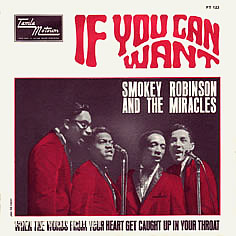
The Miracles - If You Can Want (1968/ No. 50/ 1 week/ Motown)


Normally with songs of devotional unrequited love, you're listening against the grain for one of three revelations; that the singer is a creep, that the beloved one isn't worth it, or that this is clearly a foolhardy exercise.

You don't get this here. Robinson's always-astonishing sweetness of voice manages to carry over some reasoning that looks pretty hopeless when written out;

"If you can want
you can need
and if you can need
you can care
If, baby, you can care
you can love
Whenever you want me
I'll be there"

There's a tremendous quality of openheartedness when the singer concedes that "this may take some time, but if time was money, then I would be a millionaire." Offsetting this is an arrangement that is not as light as it initially sounds, with a shuffling secondary drumbeat that adds a near subliminal sense of tension to the gentleness of Robinson's declaration. of love.

Monday, 11 April 2011

Dusty Springfield - I'll Try Anything (1967/ No. 13/ 9 weeks/ Philips)


Now, if you were only half listening to this one, you'd think that it was something pleasant and exceptionally well-arranged - especially the lovely bridge bit where the trumpet and the ooohing female backing vocals alternate. After all, songs about trying anything 'til I make you my man are a very common pop trope.

Listen closely, however, and a remarkably candid story is told here, not merely foolhardy but frankly dangerous. It's there right from the get-go;

You be-long
To somebody else and not to me
Right or - wrong
That's NOT the way that it's gonna be!

Straight into the chorus from here, and the crucial bit is delivered more quietly than the rest and on a descent, making it a confidence that the listener can easily miss;

I'll try any-thing to get you!
I'll do any-thing I can!
I'll try any-thing to get you!
(I'll cheat and I'll lie)
And I'll try 'til I die
'Til I make you my man!

(Did I just hear that right?) The second verse expounds upon how the singer has now vowed to play dirty;

I've been burned
Whenever I've followed - all the rules
So I've learned
That playing it fair is - just for fools
I'm fighting and win or lose
I'm not minding my P's and Q's

There isn't a third verse - You don't really need one after that, but we do get this in between the next to choruses;

I want you so much inside
I'm throwin' away all my conscience and pride.

There are quite a few songs about love making you giddy and reckless, which seduce you with the delirium and the headiness of the feeling nonetheless, but not many that make you so aware of the cost to one's dignity and integrity as this one.